History
Intent
Why do we teach this?
Historical knowledge of events, people and changes in the past helps children to understand the world they live in today. At Our Lady of Lourdes, we want pupils to develop a broad and secure understanding of British and world history, while gaining an awareness of how the past has shaped identities, cultures and communities over time.
Why do we teach it in the way that we do?
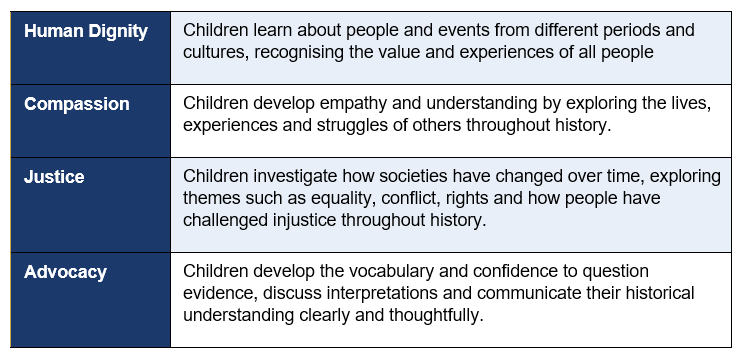
Rooted in our core values our aim is to inspire pupils to become reflective, informed and active citizens who can use their understanding of the past to make sense of the present and contribute positively to the future.
Implementation
How do we implement our vision in our school?
We teach the aims of the Early Years Framework (2026) and the National Curriculum (2014) which provides a broad framework and outlines the knowledge and skills taught in Early Years and Key Stage 1 and Key Stage 2 and use the Kapow History Scheme
What does it look like in our classrooms?
In Early Years children explore history through a balance of adult-led activities and opportunities to reflect on memories and experiences from their own past as well as comparing and contrasting people from the past and now by looking at photographs, listening to their stories and learning about their achievements.
From Reception through to Year 6, children follow three carefully planned units each year, each one building on what has come before. Children develop knowledge about the past, people, events and ideas alongside knowledge about how historians investigate the past
What does it look like in our classrooms?
In Early Years, children explore History through a balance of adult-led activities and child-led discovery within continuous provision. From Reception through to Year 6, children follow three carefully planned units each year, each one building on what has come before and developing knowledge and skills in the following areas:
Each unit supports children to begin to ‘think like historians’ by developing knowledge and skills in five different strands: topic knowledge, chronological awareness, substantive concepts (abstract ideas, such as power, conflict, civilisation and trade), disciplinary concepts (similarities and differences) and historical enquiry which equips pupils with the skills to investigate the past using evidence.
Every lesson follows a clear four-part structure:
- Recap and Recall — We begin each lesson by revisiting what pupils already know, helping them to build on secure foundations.
- Attention Grabber —. A short, engaging activity, such as a question, quick investigation or interactive discussion, designed to hook pupils into the new learning in the lesson
- Main Event — The core part of the lesson, where children engage in activities that develop their understanding of the learning objective This includes a mixture of teacher modelling, guided practice and independent or collaborative tasks.
- Wrapping Up — Each lesson ends with time to reflect on learning and give honest, kind feedback on work.
Teachers use a range of assessment for learning strategies to gauge children’s understating throughout lessons and provide verbal feedback ‘in the moment’ to ensure progress. At the end of a unit teachers use assessment quizzes and knowledge checks alongside assessment for learning as evidence for their judgements towards age-related expectations.
Impact
At Our Lady of Lourdes, we measure success not only in the skills and knowledge pupils develop, but in the kind of people they are becoming. We know our curriculum is working when our children:
- an talk confidently about what they have learned, using subject-specific vocabulary
- show clear progress in their chronological understanding, historical enquiry and interpretation
- can explain how historical events, people and societies have influenced the world today
- show competence in using evidence, sources and historical thinking skills to support their ideas and conclusions
- have acquired the knowledge and skills to build on in the next stage of their education
- approach their work with care, perseverance and a desire to do their very best
- respond to different historical perspectives and experiences with curiosity, empathy and respect
- understand how history can help us learn from the past and contribute to a fairer future
How do we monitor and review the impact of History at our school?
The History subject leader uses the following lines of enquiry to assess the impact of the history curriculum:
- The profile of historical enquiry and understanding in Early Years.
- Opportunities for historical exploration and enquiry in the indoor and outdoor classroom environments in Early Years.
- The quality of work in children’s history books
- History assessment data (Years 1-6).
- Discussions with pupils and evaluations of their ability to think as historians
- Discussions with teachers.
- Learning behaviour in the classrooms.
- Culture of History across the school.
- Extracurricular opportunities in History.