Mathematics
Intent
Why do we teach this?
At Our Lady of Lourdes, we believe that every child is made in the image of God and is capable of thinking, reasoning and solving problems. Through our Mathematics curriculum, we aim to develop confident mathematicians who are fluent in number, able to reason logically and equipped to solve problems in a wide range of contexts.
Mathematics helps children to understand and make sense of the world around them. We want pupils to develop resilience, curiosity and confidence in their mathematical ability, while recognising the importance of maths in everyday life and future opportunities. Through Mathematics, children learn to think critically, work systematically and apply their knowledge creatively to solve problems.
Why do we teach it in the way that we do?
Through the NCETM approach and Mastering Number programme, we teach Mathematics in a way that develops deep understanding, fluency and confidence for all learners. We believe children learn mathematics best through carefully sequenced learning, practical exploration, mathematical discussion and opportunities to reason and problem solve.
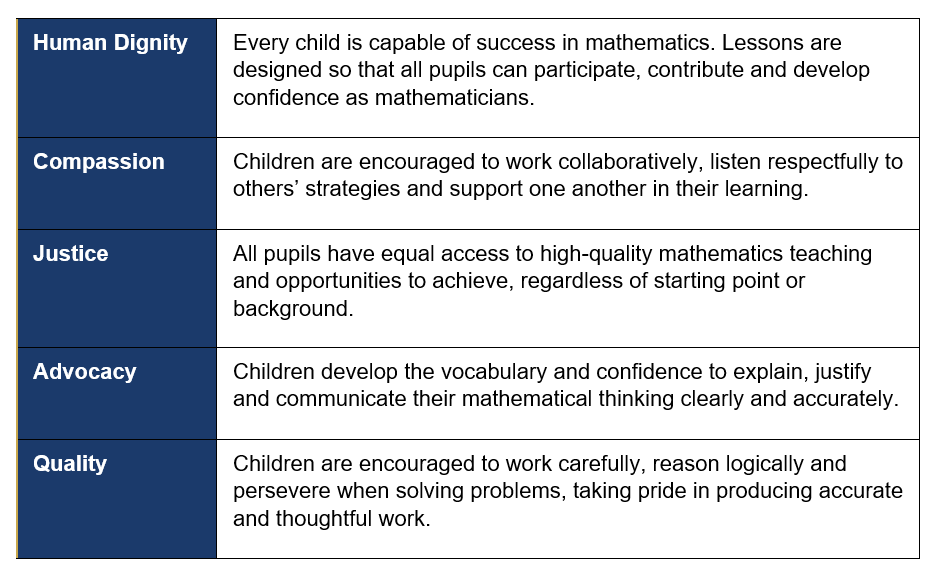
Our Mathematics curriculum is rooted in our school’s five core values:
Implementation
How do we implement our vision in our school?
We teach the aims of the Early Years Framework (2026) and the National Curriculum (2014), which provide a broad framework and outline the knowledge and skills taught in Early Years, Key Stage 1 and Key Stage 2. We use the NCETM approach alongside the Mastering Number programme to support the delivery of our Mathematics curriculum.
What does it look like in our classrooms?
In Early Years, children develop early mathematical understanding through practical exploration, play-based learning, singing, counting and adult-led activities within continuous provision. From Reception through to Year 6, children follow a carefully sequenced curriculum that develops fluency, reasoning and problem-solving skills progressively over time.
Through Mastering Number, children build secure number sense and develop confidence with number facts and calculation strategies. Lessons include opportunities to use concrete resources, pictorial representations and abstract methods to deepen understanding. Mathematical vocabulary is explicitly taught and children are encouraged to explain their reasoning and discuss different methods and strategies
Our lessons follow a clear five-part structure:
1. Review of Knowledge
We begin each lesson by revisiting prior learning through carefully chosen questions and tasks that require pupils to recall and apply previously taught knowledge. This strengthens retrieval, builds secure foundations and supports knowledge being retained in long-term memory.
2. Direct Instruction – 'I Do'
Teachers introduce new learning in small, manageable steps through clear explanations, questioning, modelling and worked examples. Appropriate scaffolds are provided to ensure all pupils can access new knowledge while being appropriately challenged.
3. Guided Practice – 'We Do'
Pupils practise new knowledge and skills alongside the teacher through carefully structured activities. Teachers continually check for understanding, provide additional models, scaffolds and checklists where needed, and address misconceptions before independent learning begins.
4. Independent Practice – 'You Do'
Pupils apply their learning independently using models, scaffolds and success criteria appropriate to their needs. This enables children to develop confidence, apply new knowledge and skills, and become increasingly independent learners.
5. Self-Review and Response to Feedback
Each lesson ends with time for pupils to review their own work using success criteria or checklists and respond to feedback. This encourages pupils to become reflective learners by identifying strengths, correcting errors, addressing misconceptions and deepening their understanding, while also providing teachers with valuable assessment information to inform future planning and teaching.
Teachers use a range of assessment for learning strategies to monitor understanding throughout lessons and provide verbal feedback ‘in the moment’ to support progress. Assessment is based on fluency, reasoning, problem-solving and children’s ability to apply mathematical knowledge in different contexts.
Impact
At Our Lady of Lourdes, we measure success not only in the skills and knowledge pupils develop, but in the kind of people they are becoming. We know our curriculum is working when our children:
- can talk confidently about what they have learned, using subject-specific mathematical vocabulary
- show clear progress in fluency, reasoning and problem-solving skills
- can explain different methods and strategies used to solve mathematical problems
- show competence in selecting efficient methods and approaches to solve problems accurately
- have acquired the knowledge and skills to build on in the next stage of their education
- approach mathematics with confidence, resilience and a desire to do their very best
- respond to challenges with curiosity, perseverance and independence
- understand how mathematics is used in everyday life and can help people make informed decisions
How do we monitor and review the impact of Mathematics at our school?
The Maths subject leader uses the following lines of enquiry to assess the impact of the Mathematics curriculum:
- The profile of mathematical learning and number fluency in Early Years
- Opportunities for mathematical exploration in the indoor and outdoor classroom environments in Early Years
- The quality of mathematical reasoning and problem-solving across the school
- Mathematics assessment data
- Evidence of the profile of mathematics around our school
- Discussions with pupils and evaluations of their confidence and understanding as mathematicians
- Discussions with teachers
- Learning behaviour in Mathematics lessons
- Culture of mathematics across the school
- Opportunities for enrichment activities linked to mathematics